For executors in CA, TX, FL, NY and IL
You were named executor. See the steps and dates that usually apply in your state.
ExecutorBench works out which settlement route your state’s rules point to, builds a task plan with the deadlines on file, tracks assets and debts, and drafts notification letters and a small estate affidavit worksheet. Start free, in a few minutes, before you decide anything else.
- Free: intake, route and your first tasks
- One-time pricing, no subscription
- Not a law firm; self-help software
How it works
Four steps, shown with the real screens
Every screenshot below is the live product running on a fictional sample estate (a California home and bank account, a will, a mortgage). Nothing is mocked up.
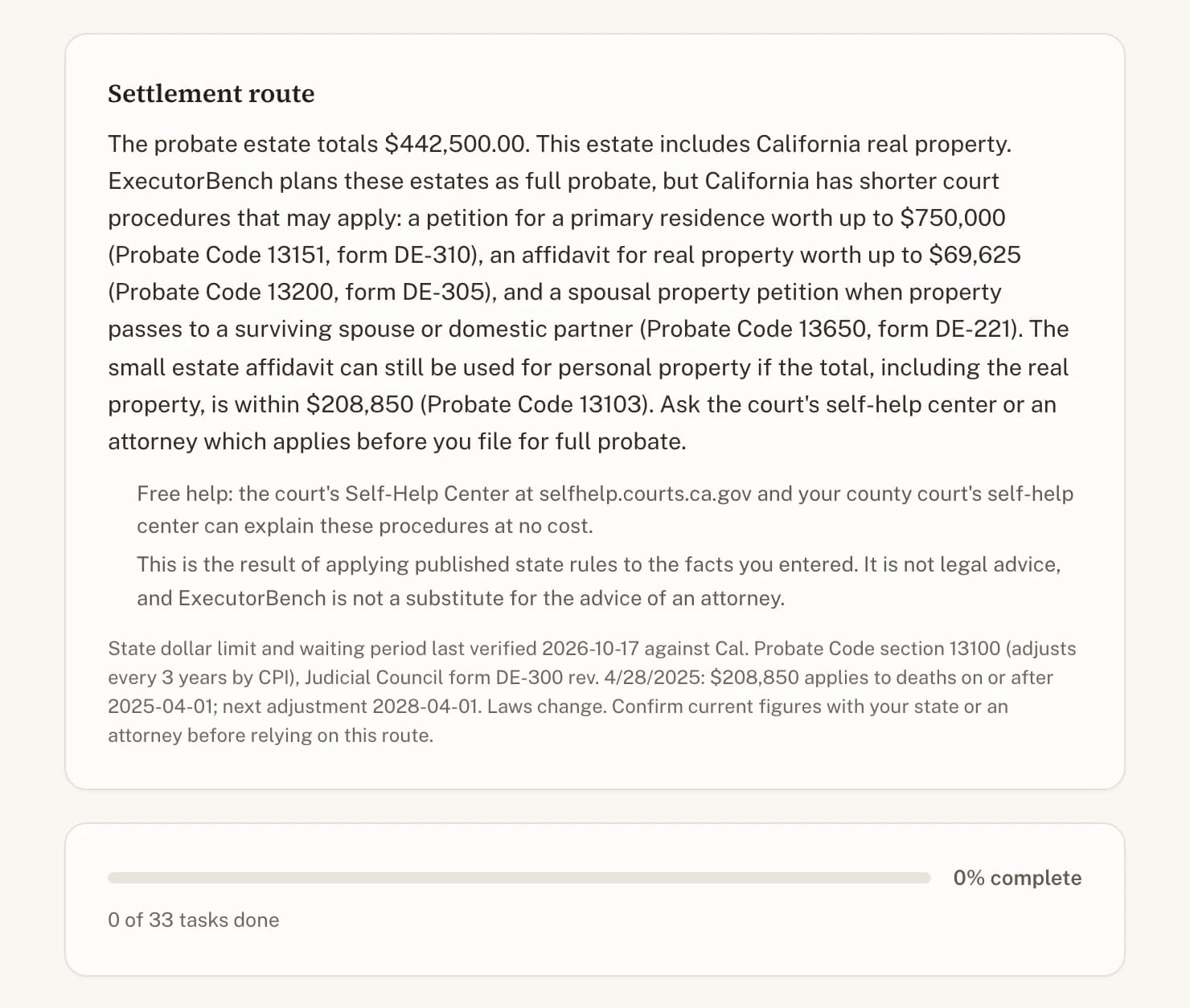
Answer a few questions, get your route
Enter the state, date of death, whether there is a will or a revocable trust, and each asset with how it is titled. The app separates probate from non-probate assets, compares the probate total with your state’s small estate limit, and tells you the route and why.
- Joint, payable-on-death, trust-titled and beneficiary-designated assets pass outside probate
- The limit is picked by date of death where the law changed (CA, IL)
- It says when a will or real estate takes an estate outside the route the app plans, and names other procedures to ask about
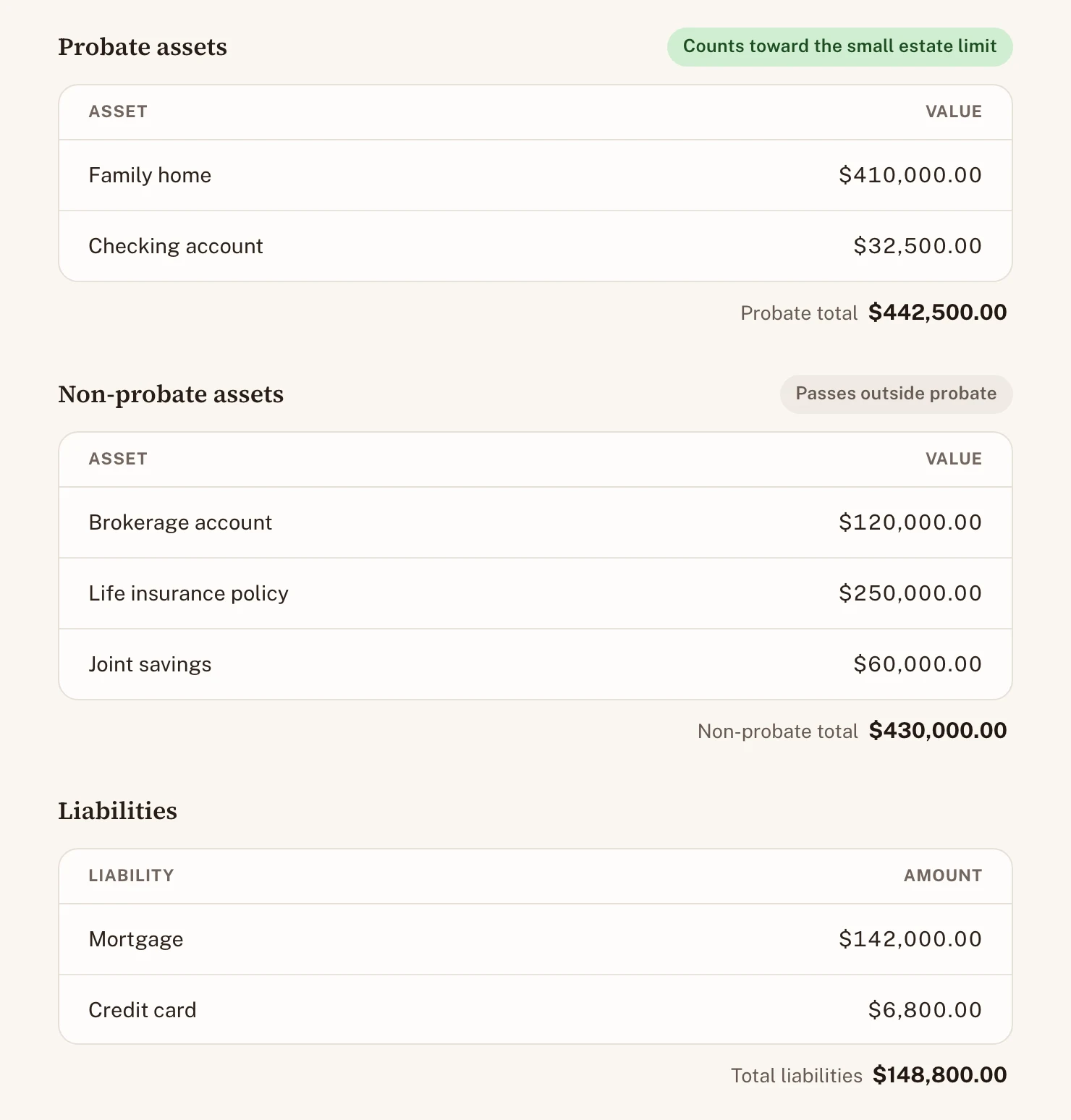
Asset and debt inventory with probate and non-probate assets sorted for you.
Get a task plan with the deadlines on file
Your plan is built from a 57-task library, filtered to your route and state. Each task has a due date computed from the date of death, the date letters are issued or the notice publication date, and tasks that depend on others show as blocked until their prerequisite is done.
- Enter the letters date and publication date when you have them; every date recomputes
- Overdue and blocked tasks are marked, so the next step is always clear
- Free accounts see the first (immediate) tasks; Guided and Complete unlock the full plan
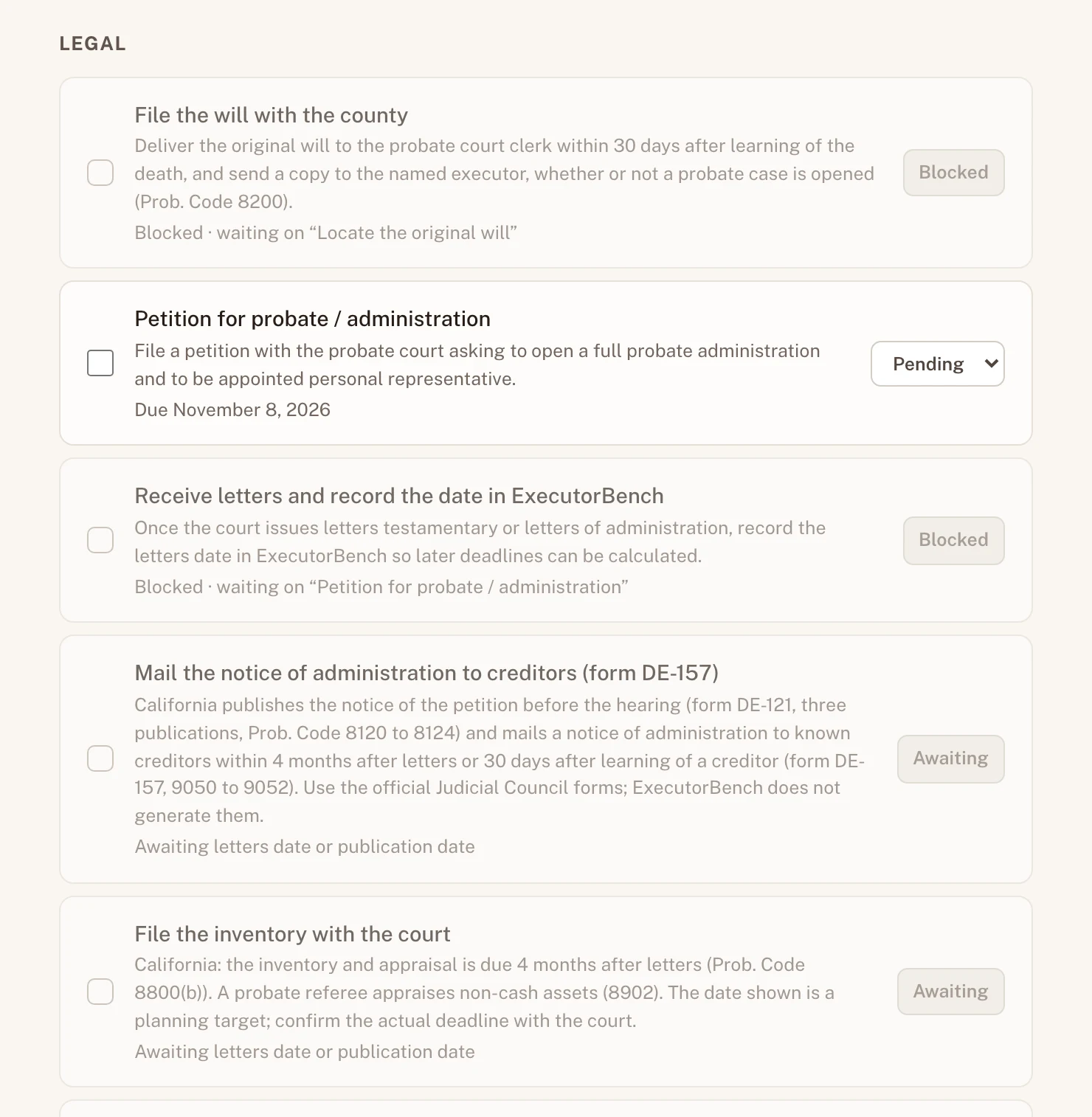
The legal section of a full probate plan, with dependencies.
Generate the letters and notices
On the Complete tier, the app fills in drafts from what you entered: notification letters to institutions and credit bureaus, a small estate affidavit worksheet, an information worksheet for the notice to creditors (not a notice, and not for publication) and an estate asset and debt summary. Anything it does not know is marked NOT ON FILE rather than guessed. It does not generate court forms.
- Notification letters (banks and brokerages, creditors, insurers and employers)
- Credit bureau notification letter
- Notice-to-creditors information worksheet (not for publication)
- Small estate affidavit worksheet
- Estate asset and debt summary
Drafts for you to review. Confirm wording and filing rules with the court clerk or an attorney.
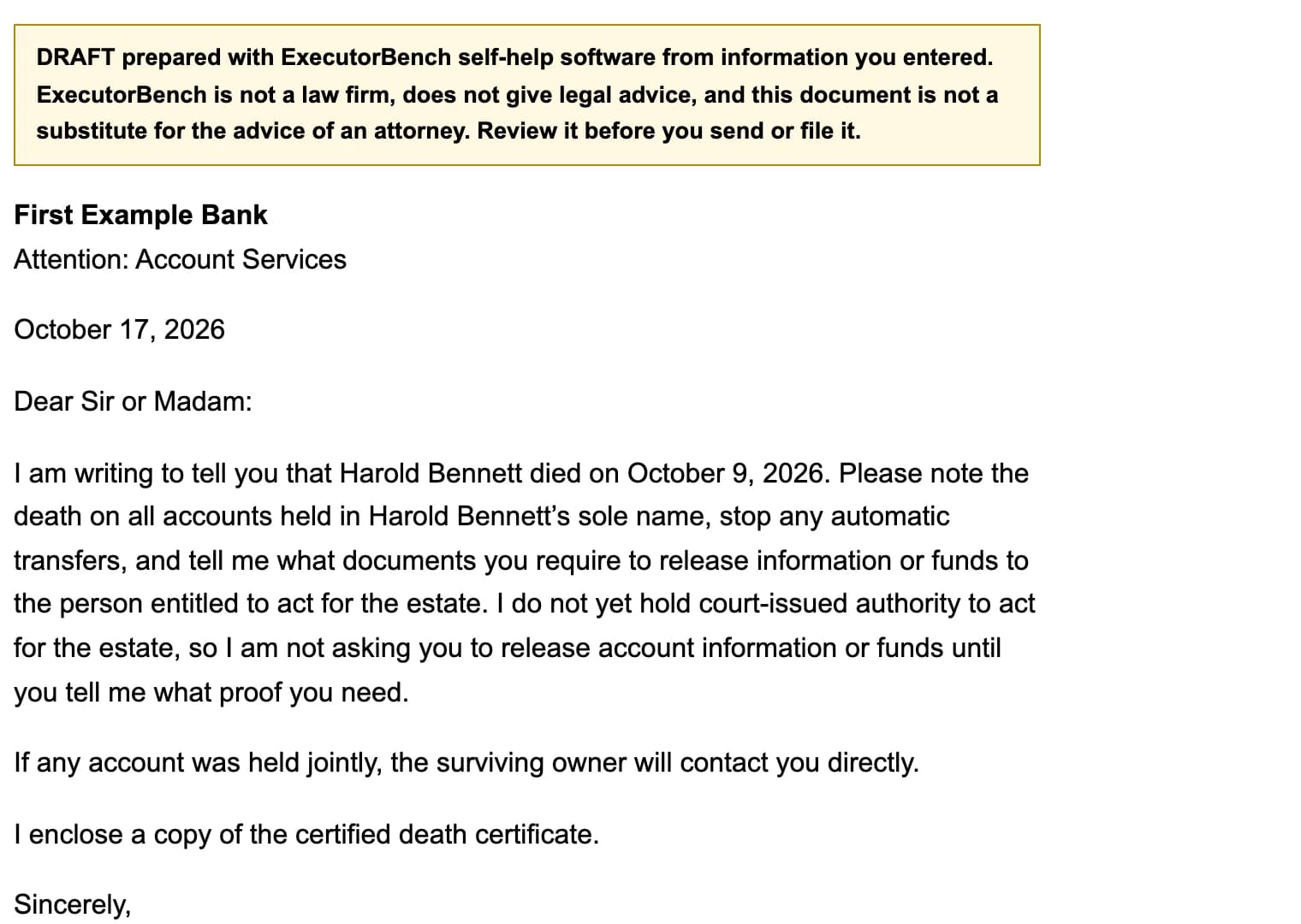
A generated letter. It claims only the authority the sender has, and missing facts are flagged, not invented.
Keep beneficiaries informed without the phone calls
Share a read-only link with family. They see the route, overall progress and key dates. Dollar amounts stay hidden unless you choose to show them, and you can revoke the link at any time.
- No account needed for the people you share with
- Revoking a link cuts off access immediately
- Included in the Complete tier
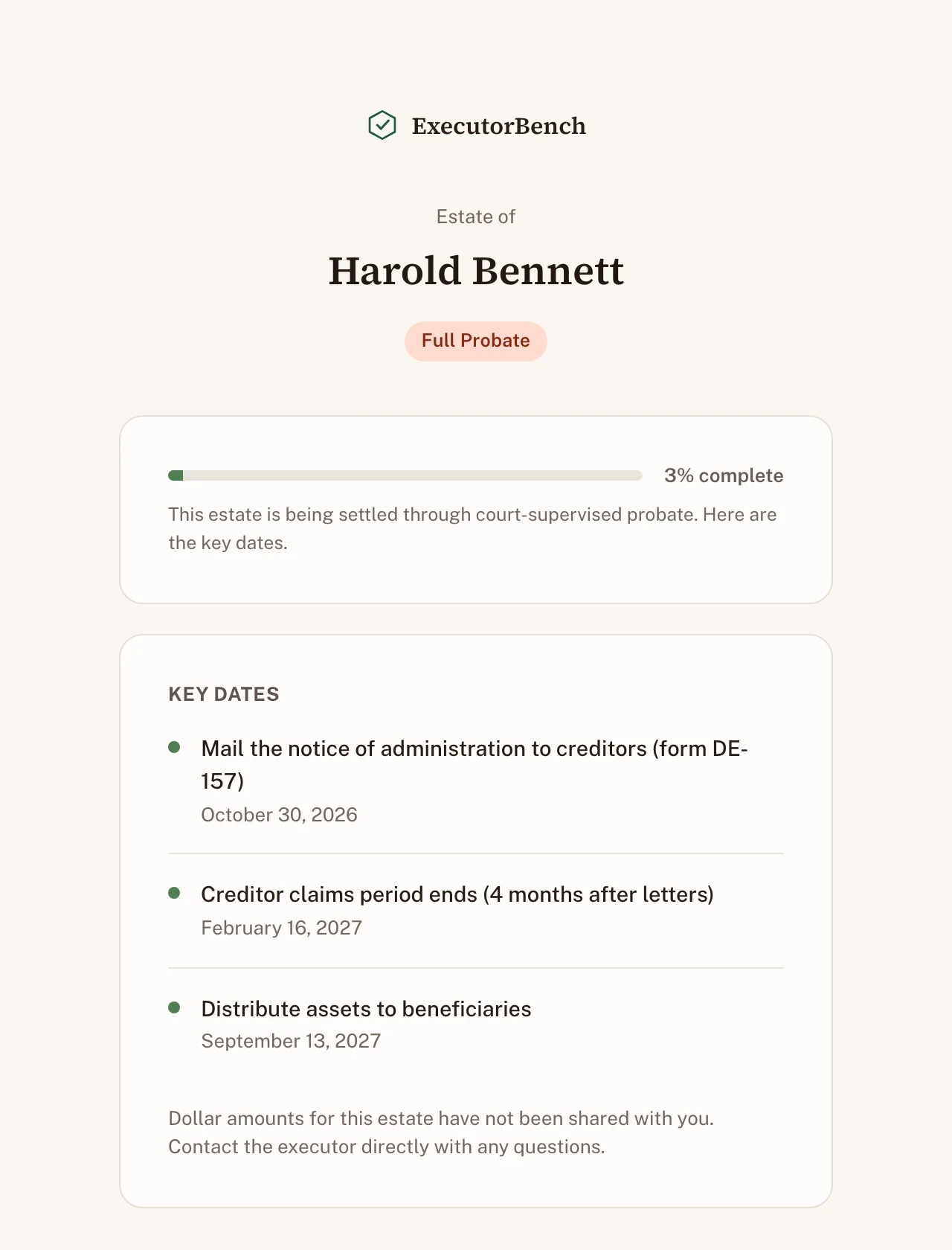
The read-only beneficiary portal.
What the job involves
Being an executor is mostly dates, notices and records
Most of the stress comes from not knowing which dates are real. These are the ones that matter most, with sources. None of this is a reason to panic: nearly all of it is routine once it is written down in order.
The original will goes to the court first
Where there is a will, whoever holds the original has a short window to deliver it:
- California: the person holding the original will must deliver it to the court within 30 days of learning of the death (Cal. Prob. Code 8200)
- Florida: the person holding the original will must deliver it to the court within 10 days of learning of the death (Fla. Stat. 732.901)
- Illinois: the person holding the original will must file it with the court clerk immediately upon the death (hiding it for 30 days after learning of the death is a felony) (755 ILCS 5/6-1)
Texas and New York set different timing; the state guides cover them.
Creditors have claims rules
Debts are paid before beneficiaries are. How and when creditors can make claims differs by state, and where a date applies it starts at a court event, so it moves with your timeline:
- CA: 4 months after letters, or 60 days after mailed notice if later
- TX: No general deadline; 121 days after a creditor receives notice (308.054)
- FL: 3 months after first publication (30 days after service if later); 2-year bar
- NY: No bar date; 7-month good-faith protection (SCPA 1802)
- IL: At least 6 months after first publication (3 months after mailing if later); 2-year bar
The figures ExecutorBench uses to date your plan. See the table below.
The court wants an inventory
Formal probate usually requires listing what the estate owns, on a schedule that depends on your state:
- CA: 4 months after letters
- TX: 90 days after qualifying
- FL: 60 days after letters
- NY: 9 months after letters
- IL: 60 days after letters (supervised administration)
Inventory dates apply to routes that involve a court-appointed personal representative.
Final income tax return
The decedent’s last federal return (Form 1040) is due April 15 of the year after death, moved to the next business day when that falls on a weekend or a D.C. holiday. A return is required if the decedent’s income was over the filing threshold. The plan schedules it automatically.
Source: IRS, Filing a Final Federal Tax Return for Someone Who Has Died.
The estate may need its own return
If the estate earns $600 or more in gross income in a year (interest, dividends, rent), it files Form 1041. Separately, a federal estate tax return (Form 706) is due 9 months after death, but is required only for estates above the federal exclusion, which is $15,000,000 for deaths in 2026.
Sources: IRS Form 1041 instructions; IRS “Estate tax” page. Most estates owe no federal estate tax.
Paying debts in the right order
A representative who pays other debts before a federal claim can be personally liable up to the amount paid (31 U.S.C. 3713(b)). Late tax filing carries a penalty of 5% of the unpaid tax per month, up to 25% (26 U.S.C. 6651). That is why the plan puts notifications, accounts and taxes ahead of distributions.
General information, not advice for your situation.
Want the long version? Read the executor checklist or what an executor does first.
State coverage
Small estate limits and deadlines, by state
This table is generated from the same state rules the app uses to route estates and date your tasks. Each row was last checked against the statute on 2026-10-17.
| State | Streamlined route | Dollar limit | Real property | Waiting period | Inventory | Creditor claims | Statute |
|---|---|---|---|---|---|---|---|
| California | Small Estate Affidavit | $208,850 | Counts toward the limit; the affidavit cannot transfer it (other CA procedures exist) | 40 days | 4 months after letters | 4 months after letters, or 60 days after mailed notice if later | Cal. Prob. Code 13100 |
| Texas | Small Estate Affidavit | $75,000 | Not allowed, except a sole homestead | 30 days | 90 days after qualifying | No general deadline; 121 days after a creditor receives notice (308.054) | Tex. Estates Code 205.001 |
| Florida | Summary Administration | $150,000 | Counts toward the limit; homestead is generally not counted | None built in | 60 days after letters | 3 months after first publication (30 days after service if later); 2-year bar | Fla. Stat. 735.201 |
| New York | Voluntary Administration | $50,000 | Not covered; personal property can still use it | None built in | 9 months after letters | No bar date; 7-month good-faith protection (SCPA 1802) | N.Y. SCPA 1301 to 1304 |
| Illinois | Small Estate Affidavit | $150,000 | Not allowed | None built in | 60 days after letters (supervised administration) | At least 6 months after first publication (3 months after mailing if later); 2-year bar | 755 ILCS 5/25-1 |
- CA: the $208,850 limit applies to deaths on or after 2025-04-01. Earlier deaths use an earlier limit, which the app applies automatically.
- IL: the $150,000 limit applies to deaths on or after 2025-08-15. Earlier deaths use an earlier limit, which the app applies automatically.
- Limits are tested against the value of probate assets, and some states exclude certain items (for example registered vehicles in California). Laws change and counties differ: confirm current figures with the court or an attorney before relying on a route.
In Florida a personal representative must be represented by a Florida attorney unless the personal representative is the only interested person (Florida Probate Rule 5.030(a)); in most Texas and Illinois courts a personal representative in a full probate case must have an attorney. In those states ExecutorBench helps you organize the work, track deadlines and work efficiently with your attorney; it does not present court filings as something to do yourself.
What is inside
Everything in one place, nothing hidden
Each item below is a feature that exists in the product today.
Route engine
Classifies every asset as probate or non-probate, applies your state’s small estate limit for the date of death, and explains the result in a sentence you can read to a relative.
Statutory deadlines
Dates for inventory, creditor claims and notices come from your state’s rules and the court dates you enter, not from a generic calendar.
Task dependencies
Tasks that cannot start yet are marked blocked and name what they are waiting on, so you always know the next step.
Asset and debt inventory
Banks, brokerage, retirement, insurance, real estate, vehicles and more, with how each is titled, plus mortgages, cards, loans, medical and tax debts.
Document drafts
5 templates (letters, a notice-to-creditors information worksheet, an affidavit worksheet, an asset and debt summary) filled from your data, with gaps marked.
Beneficiary portal
Read-only link for family showing route, progress and key dates. Values hidden by default. Revocable any time.
Automatic recompute
Change a date, an asset or an intake answer and the route and task dates update. It asks you to confirm before removing tasks you have already completed.
Free tools and guides
An eligibility checker, a cost estimator and a library of state and national guides, all usable without an account.
Secure sign-in
Email and password with email verification, or Sign in with Google. Passwords are stored as salted hashes.
Cost context
What probate legal fees look like, and where software fits
Attorney fees are one of the biggest line items in a formal probate. California is the clearest example because the fee is set by statute. These are published schedule amounts, not a promise of what you would pay or save.
| Estate value | Attorney fee | Attorney plus personal rep.* |
|---|---|---|
| $250,000 | $8,000 | $16,000 combined |
| $500,000 | $13,000 | $26,000 combined |
| $1,000,000 | $23,000 | $46,000 combined |
Schedule: 4% of the first $100,000, 3% of the next $100,000, 2% of the next $800,000, 1% of the next $9,000,000, 0.5% of the next $15,000,000, then a reasonable amount set by the court. Extraordinary services are charged on top (Prob. Code 10811). *The personal representative is entitled to the same schedule (Prob. Code 10800) and can waive it. Estate value means the value of the estate accounted for, which is usually the probate estate, not assets that pass outside probate, computed on the gross value without subtracting mortgages or other debts (Prob. Code 10810(b)).
Other ballparks (national, not state-specific)
- Attorney, streamlined small estate procedure: $1,500 - $3,000 (flat fee, if you hire one)
- Attorney, full probate administration: $5,000 - $15,000 (flat fee or hourly)
These come from our free cost estimator, which labels them as typical ranges. Other states use different schedules or a “reasonable fee” standard.
ExecutorBench
Free to start. A personalized plan PDF is $29, Guided is $199and Complete is $499, each one time, per estate.
Pricing
One-time price per estate. No subscription.
Prices are in US dollars and shown before you pay. Every plan is computed from your own estate: your state’s statutory logic and your date of death, not a generic checklist. Upgrading from Guided to Complete costs only the difference ($300).
To get oriented, with no card.
A personalized document built from your intake. Credited toward Guided or Complete.
For people who want the full task plan, tracked as they go.
Adds the document drafts and the family portal.
You choose a paid option inside an estate, after you have seen your route. Guided and Complete carry a full refund within 14 days if no documents have been generated (see the Terms of Service). ExecutorBench is self-help software. It is not a law firm, it does not give legal advice, and it is not a substitute for the advice of an attorney.
Free, no account
Start with the tools and guides
You do not need to sign up to find out where you stand.
Small estate eligibility checker
Answer a few questions to see whether your state’s streamlined route applies.
Probate cost estimator
Typical court and professional costs for your state and route, labeled as ranges.
Estate settlement guides
State and national articles: checklists, timelines, costs, and what avoids probate.
Questions
Frequently asked questions
Do I need to go through probate?
Not always. Whether an estate needs probate depends on your state, what the person owned and how it was titled. Assets that pass by joint ownership, a beneficiary designation or a trust generally skip probate. Small estates in many states can use a streamlined procedure such as a small estate affidavit. ExecutorBench asks about the will, any trust and each asset, then shows which route your state's rules point to and why. The free eligibility checker gives a first answer in a couple of minutes without an account.
What are the settlement routes ExecutorBench plans?
Small estate affidavit (California, Texas, Illinois), summary administration (Florida), voluntary administration (New York), full probate, trust administration when a revocable trust holds everything and nothing is left in probate, and "no probate appears needed" when every asset passes outside probate. For any other state the app gives a plan of universal tasks only and says so.
Is ExecutorBench a law firm? Do I still need a lawyer?
No. ExecutorBench is self-help software. It is not a law firm, it does not give legal advice, and it is not a substitute for the advice of an attorney. Using it does not create an attorney-client relationship, and what you enter is not protected by attorney-client privilege. Some estates are complicated enough that an attorney is worth consulting, for example a contested will, a business, out-of-state property or a large taxable estate. In Florida a personal representative must be represented by a Florida attorney unless the personal representative is the only interested person (Florida Probate Rule 5.030(a)), and in most Texas and Illinois courts a personal representative in a full probate case must have an attorney. Ask the court clerk what your court expects. Documents the app generates are drafts to review before you file or send them.
Which states does it cover?
California, Texas, Florida, New York and Illinois, in depth: state-specific small estate limits, routes, waiting periods and deadlines. Other states can still use the universal task plan, but without state-specific rules.
Where do the deadlines and dollar limits come from?
From the state rules the app stores, each with a source and a last-verified date. The statutes behind them are named in the state coverage table on this page. Laws change and courts and counties differ, so the product tells you to confirm current figures with the court or an attorney before relying on a route. Where the real deadline depends on a court date (for example the date letters are issued), the app asks you to enter that date and recomputes your plan.
What do I get for free?
Intake, the settlement route with the reason for it, and the first tasks in your plan (the immediate ones such as getting death certificates, securing the home and locating the will). The eligibility checker, cost estimator and state guides need no account at all.
What is the difference between Guided and Complete?
Guided ($199) unlocks the full task plan with the state deadlines ExecutorBench tracks for your state, the asset and liability inventory, and automatic recompute as facts change. Complete ($499) adds everything in Guided plus document drafts (institution and credit bureau letters, a notice-to-creditors information worksheet, a small estate affidavit worksheet, an estate asset and debt summary) and the read-only beneficiary portal. If you only want a document to work from, the Estate Action Plan PDF ($29, one time) is a personalized plan computed from your intake, and its price is credited toward your first Guided or Complete purchase.
What is the Estate Action Plan PDF, and how is it different from a generic checklist?
It is a personalized PDF ($29, one time) built from your intake. It states your settlement route and why, lists every task in order with calendar deadlines worked out from your date of death, shows your state's small estate limit and what counts toward it, and lists the court documents typically used for your route and a document checklist. Generic checklists give the same list to everyone; this one is computed from your own estate and your state's rules. Your $29 is credited toward your first Guided or Complete purchase.
Is it a subscription? What if I upgrade later?
No. Everything is a one-time payment for a single estate, in US dollars, with no renewal. If you start with Guided and later want Complete, you pay only the difference ($300).
What is the refund policy?
For Guided and Complete, you can ask for a full refund within 14 days of purchase as long as no documents have been generated for the estate. After 14 days, or once any document has been generated, payments are not refundable except where the law requires it. For an upgrade, the 14 days run from the upgrade and the refund covers the upgrade charge. The full text is in the Terms of Service.
What documents can it generate?
On the Complete tier: notification letters (to banks and brokerages, to creditors, and to insurers, employers and pension plans), a credit bureau notification letter, a notice-to-creditors information worksheet (Texas, Florida and Illinois only; it is not a notice and is not for publication), a small estate affidavit worksheet and an estate asset and debt summary. They fill in what you entered, and they mark facts that are not on file so you can see what is missing. They are drafts for you to review, not court filings: ExecutorBench does not generate court forms, and California uses official Judicial Council forms (DE-121, DE-157) instead.
Who can see the estate information? What is the beneficiary portal?
Only the account owner, plus anyone you give a share link. The portal is read-only and shows the settlement route, overall progress and key dates. Dollar amounts are hidden unless you turn them on, and you can revoke a link at any time to cut off access immediately.
How is my data protected?
Passwords are stored as salted hashes, traffic is encrypted over HTTPS, and card details go to Stripe and never reach our servers. We use one session cookie to keep you signed in. Marketing pages and the purchase confirmation use third-party advertising and measurement tags (Google Ads); estate information is never sent to them. See the Privacy Policy for details and how to opt out. We do not sell personal information or use estate data for advertising. You can ask us to delete your account and data at any time through the feedback form.
How long does settling an estate take?
It varies widely with the route, the court and whether anyone contests anything. Small estate procedures can be quick; full probate commonly runs many months. The default plan schedules closing tasks out to roughly 13 months after intake, and it recomputes as you enter real dates. Our how-long-does-probate-take guide goes into the ranges.
Trust and privacy
What we are, and what we are not
Not a law firm
ExecutorBench is self-help software. It is not a law firm, it does not give legal advice, and it is not a substitute for the advice of an attorney. Using it does not create an attorney-client relationship, and what you enter is not protected by attorney-client privilege. Laws change and vary by county, so confirm figures with the court or an attorney before relying on them.
Security and privacy
- Passwords stored as salted hashes; traffic encrypted with HTTPS
- Card details handled by Stripe, never on our servers
- Marketing pages and the purchase confirmation use third-party advertising and measurement tags (Google Ads); estate information is never sent to them. See the Privacy Policy for details and how to opt out
- We do not sell personal information or use estate data for ads
- Delete your account and data on request
Read the Privacy Policy.
Refunds and terms
Full refund within 14 days of purchase if no documents have been generated for the estate. One-time payments, never a subscription. Details in the Terms of Service.
Who runs it
ExecutorBench is operated by Buckshot Digital Sales Inc., Markham, Ontario, Canada. Questions or a problem? Use the feedback form.
Take the first step today
Find out in a few minutes whether you need probate. It is free, and you do not need an account.
We are sorry for your loss. Take the steps one at a time.